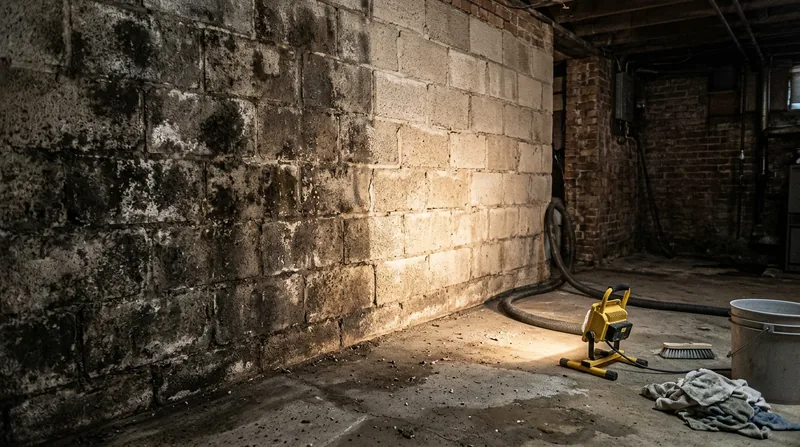




Basement Mold Remediation in Pueblo: Fix the Moisture, Not Just the Mold
If you smell that damp, earthy odor every time you walk down the basement stairs, you are not imagining it. Basement mold remediation in Pueblo starts with finding the water source, not just scrubbing the walls. Pueblo's heavy clay and Pierre shale ground swells when wet and shrinks when dry, and that movement cracks foundations and lets groundwater seep in. In older Bessemer and Mesa Junction homes, stone and brick cellars wick moisture straight through the mortar. Out in Pueblo West, where most homes sit on slab, the problem usually shows up as efflorescence and musty odors along the slab edge. We treat the mold, then fix the drainage and humidity so it does not come back. Call (719) 717-3300 for a free basement inspection.
Why Basement Mold Grows So Fast in Pueblo's Old Cellars and New Slabs
Pueblo sits in a semi-arid climate, but that does not mean basements stay dry. The Arkansas River and Fountain Creek valleys hold water through spring snowmelt, and summer monsoon storms dump hard runoff off the foothills in a matter of hours. That water pushes against foundation walls as hydrostatic pressure and finds every crack. Once it is inside, the basement stays humid, and mold colonizes drywall, framing, and stored belongings within days. The high dry sun and sharp temperature swings above grade stress the same cracks year after year.
- Hydrostatic pressure forces water through block cores and mortar joints after heavy rain.
- Failed drain tile lets water pool at the footing instead of draining away from the house.
- Sump pump failure during a monsoon storm leaves the basin full and the floor wet.
- Poor grading and short downspouts dump roof water right against the foundation.
- Missing vapor barrier lets ground moisture rise through the slab and condense on cool surfaces.
Every one of these problems is fixable, but the mold will return until the moisture source is corrected.
Key info: In Pueblo's 1900s brick and stone cellars, we often find mold growing on the back of furred-out walls where no one can see it. The musty smell is the first clue, and a moisture meter confirms it before we open anything up.
For official guidance on moisture and mold in buildings, the U.S. Environmental Protection Agency publishes a free guide at epa.gov/mold. It is a useful starting point, but it does not replace an on-site look at your foundation and drainage.
How We Run Basement Mold Remediation in Pueblo Homes
We do not just spray and walk away. The job starts with a musty smell diagnostic and a full moisture survey of the basement, including the base of every wall, the slab perimeter, and any framed cavities. We use a pin-type moisture meter and a thermal camera to map where water is actually getting in. Then we set up containment so spores do not spread to the rest of the house while we work.
- We isolate the affected area with plastic sheeting and run a HEPA air scrubber to keep dust and spores contained.
- We remove and bag porous materials that cannot be cleaned, such as soggy drywall, insulation, and cardboard.
- We wire-brush and HEPA-vacuum structural surfaces, then treat them with an EPA-registered antimicrobial.
- We dry the space with commercial dehumidifiers and air movers until framing and slab read dry on the meter.
- We fix the water source, whether that means sealing cracks, extending downspouts, installing a sump pump, or adding an interior perimeter drain.
- We re-check moisture levels after a rain event or a week of normal use before we call the job closed.
The moisture fix is the part that matters most, and it is the part most mold-only companies skip.
Key info: A homeowner in Pueblo West called us after finding black staining along the base of a finished wall. The slab was dry to the touch, but the meter read 28 percent moisture at the bottom plate. The cause was a failed window well drain on the north side, not a plumbing leak. We cleaned and treated the framing, replaced the damaged drywall, and repaired the window well drainage.
If the inspection shows water coming through the wall rather than trapped humidity, we move to foundation crack repair or a full drainage solution before any remediation work begins.
Remediation and Moisture Control Methods We Use
Not every basement needs the same approach. A single hairline crack above grade behaves differently from a bowed block wall holding back saturated clay. The table below shows the methods we use most often in Pueblo and what each one is actually for.
| Approach | Description | Best for |
|---|---|---|
| Surface treatment and HEPA cleaning | Containment, HEPA vacuuming, antimicrobial treatment of structural surfaces | Light surface mold on block or concrete walls with no active leak |
| Material removal and rebuild | Cut out wet drywall and insulation, treat framing, replace with moisture-resistant materials | Finished basements where mold has spread behind the wall surface |
| Crack injection and wall sealing | Epoxy or polyurethane injection into cracks, plus basement wall sealing to stop seepage | Water entering through visible cracks or porous block walls |
| Interior drain tile and sump pump | Perimeter drain at the footing, sump basin, and discharge line to move water out | Hydrostatic pressure and recurring floor seepage after rain |
| Dehumidification and vapor barrier | Sealed vapor barrier and controlled dehumidification to keep humidity below mold threshold | Humidity-driven mold with no active water intrusion |
We choose the lightest method that actually solves the problem, and we tell you plainly when a simple crack seal is enough.
Basement Mold Remediation Cost in Pueblo: What to Expect
Most basement mold remediation jobs in Pueblo start around From $1,500 for a contained area with a straightforward moisture fix. That figure covers containment, HEPA cleaning, antimicrobial treatment, and drying. The price moves up when the affected area is larger, when finished materials have to be removed and replaced, or when the water source needs real drainage work.
- Square footage affected is the biggest driver, since containment and drying equipment scale with the area.
- Finished versus unfinished walls changes the labor, because drywall and insulation often have to come out.
- The moisture fix itself can range from a crack injection to a full interior drain tile and sump pump installation.
- Access matters in old Bessemer cellars with low headroom and narrow stairs, where equipment is harder to move.
- Urgency can add cost if a monsoon storm has already flooded the space and drying has to start immediately.
We recommend getting two or three written estimates so you can compare scope, not just the bottom line. A low bid that skips the moisture fix will cost more later. You can see how we break down our numbers on our pricing page.
Basement Mold Remediation Near Me: How to Choose a Contractor Near Pueblo
Finding a contractor near Pueblo who actually understands below-grade water is harder than it sounds. Many general handymen will treat the mold and leave the drainage alone. Ask questions before you sign anything, and do not be shy about it.
- Licensed and insured is the baseline, and you should ask for a certificate of insurance before work starts.
- Get at least three estimates in writing, with a clear scope of what is included and what is not.
- Ask for local references from Pueblo, Pueblo West, or Canon City jobs and call them.
- Understand permits for structural repair or drainage changes, and verify requirements with the local building department since rules vary by jurisdiction.
- Check HOA rules if you live in a subdivision with exterior drainage restrictions before any work begins.
A contractor who cannot explain how water is getting in is not the right person for the job. Reach out through our contact page when you are ready to schedule an inspection.
Key info: In Florence and Penrose, we often see mold in basements that were finished decades ago with no vapor barrier under the slab. The fix there is usually a sealed vapor barrier and controlled dehumidification, not excavation.
Basement Mold Remediation in Pueblo: Pricing Guide
| Service | Price | Details |
|---|---|---|
| Contained surface remediation | Starting at $1,500 | Includes containment, HEPA cleaning, antimicrobial treatment, and drying for a single affected area |
| Finished basement remediation | Starting at $2,800 | Adds removal of wet drywall and insulation, treatment of framing, and moisture-resistant rebuild |
| Remediation plus drainage fix | On estimate | Cost depends on whether the fix is crack injection, wall sealing, or a full interior drain tile system |
| Travel | Included | in Pueblo and surrounding areas, no separate call-out or mileage fee |
| Estimate | Free | Response within 24h at (719) 717-3300, no obligation to book |
Indicative pricing, the exact cost depends on square footage, finish, and site access. Free personalized estimate within 24h at (719) 717-3300.


